
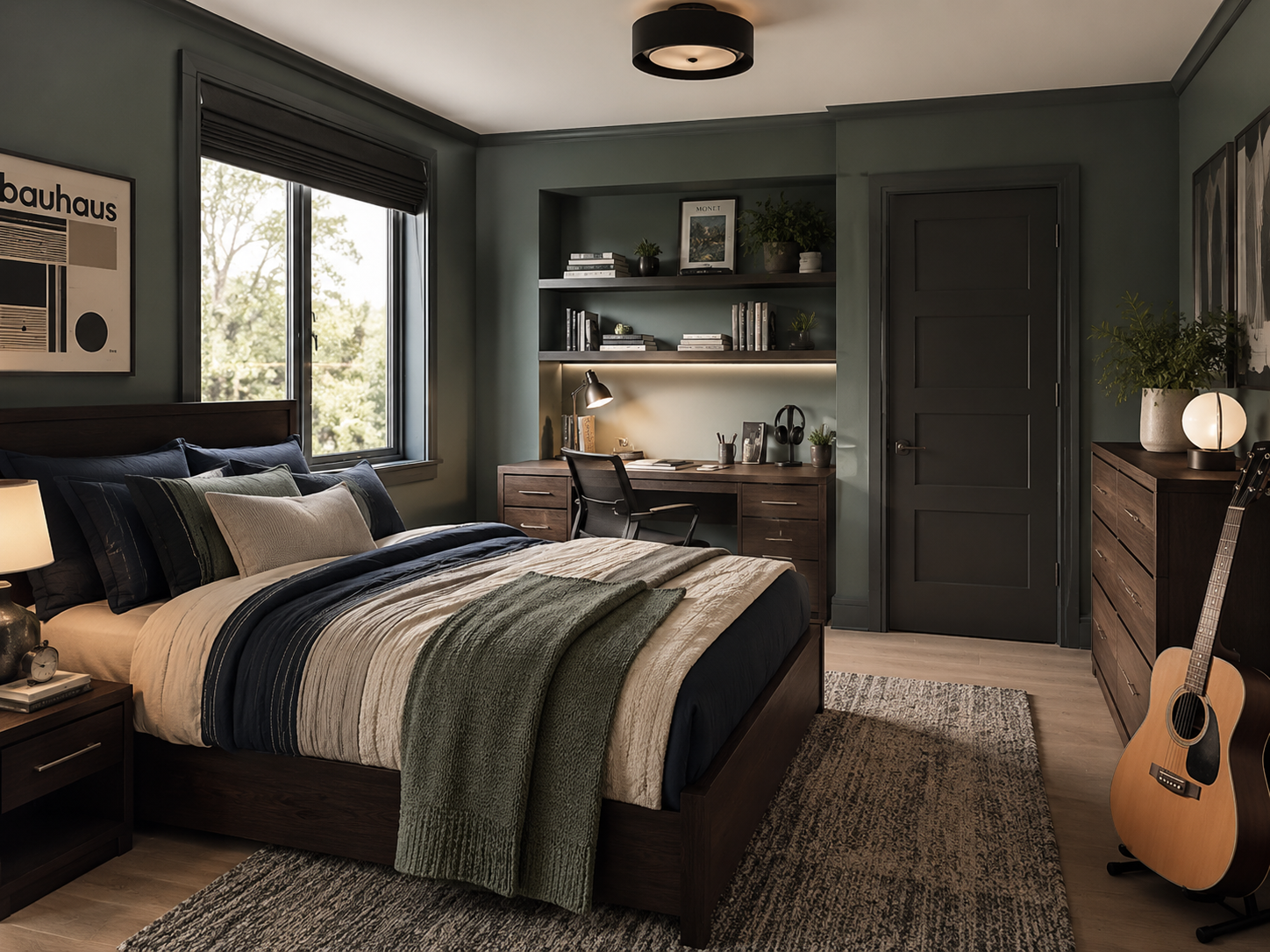
The best approach is to choose a flexible base color, test it in the room’s actual lighting, and add stronger colors through features that can be changed as interests evolve. Wilmington homeowners should also consider bright coastal sunlight, indoor humidity, washable paint finishes, and lead-safe preparation in homes built before 1978.
- Best calming colors: Cool Blue, muted jade, steely green, and soft blue-gray
- Best adaptable neutrals: Warm khaki, mushroom, taupe, and creamy off-white
- Best dramatic colors: Deep blue-green, espresso brown, charcoal, and Plum Noir
- Best accent colors: Persimmon, rust, Wasabi green, mustard, and strong cobalt
- Best 2026 techniques: Color drenching, gradient walls, painted ceilings, geometric blocking, and tonal stripes
- Best practical finish: A washable matte or eggshell on walls, with satin or semi-gloss on trim
A boy’s bedroom does not have to follow a sports, nautical, automotive, or superhero theme. A well-designed room can reflect individual interests while using paint choices that remain attractive for years. The goal is to create a bedroom that feels personal now without making every surface difficult to update later.
What Paint Colors Are Popular for Boys’ Bedrooms in 2026?
Paint forecasts for 2026 show two major directions. One emphasizes warm, grounded colors that feel timeless, while the other embraces clearer and more expressive shades. This gives homeowners more freedom than the all-gray interiors that dominated previous years.
Sherwin-Williams selected Universal Khaki SW 6150 as its 2026 Color of the Year. Benjamin Moore selected Silhouette AF-655, a deep brown influenced by burnt umber and charcoal. Behr chose Hidden Gem N430-6A, a smoky jade that combines blue and green.
Pinterest’s official 2026 palette adds a more colorful perspective with Cool Blue, Jade, Plum Noir, Wasabi, and Persimmon. These colors are useful for boys’ bedrooms because they range from restful and nature-inspired to bright and energetic.
Is Cool Blue Still a Good Bedroom Color in 2026?
Blue remains a practical bedroom color, but the most current versions are softer, lighter, or more complex than standard primary blue. Cool Blue is an icy, pale shade that can make a room feel fresh without turning it into a highly themed space.
Cool Blue works especially well in Wilmington homes because it complements bright natural light, pale woods, woven textures, white trim, and coastal materials. The room does not need anchors, boats, or beach signs to feel connected to its surroundings.
- Pair Cool Blue with warm white, light oak, camel, rust, or muted navy.
- Use it on all four walls when the room needs a lighter foundation.
- Add deeper blue through bedding, curtains, furniture, or a painted desk.
- Avoid combining pale blue with too many cool grays, which can make the room feel flat.
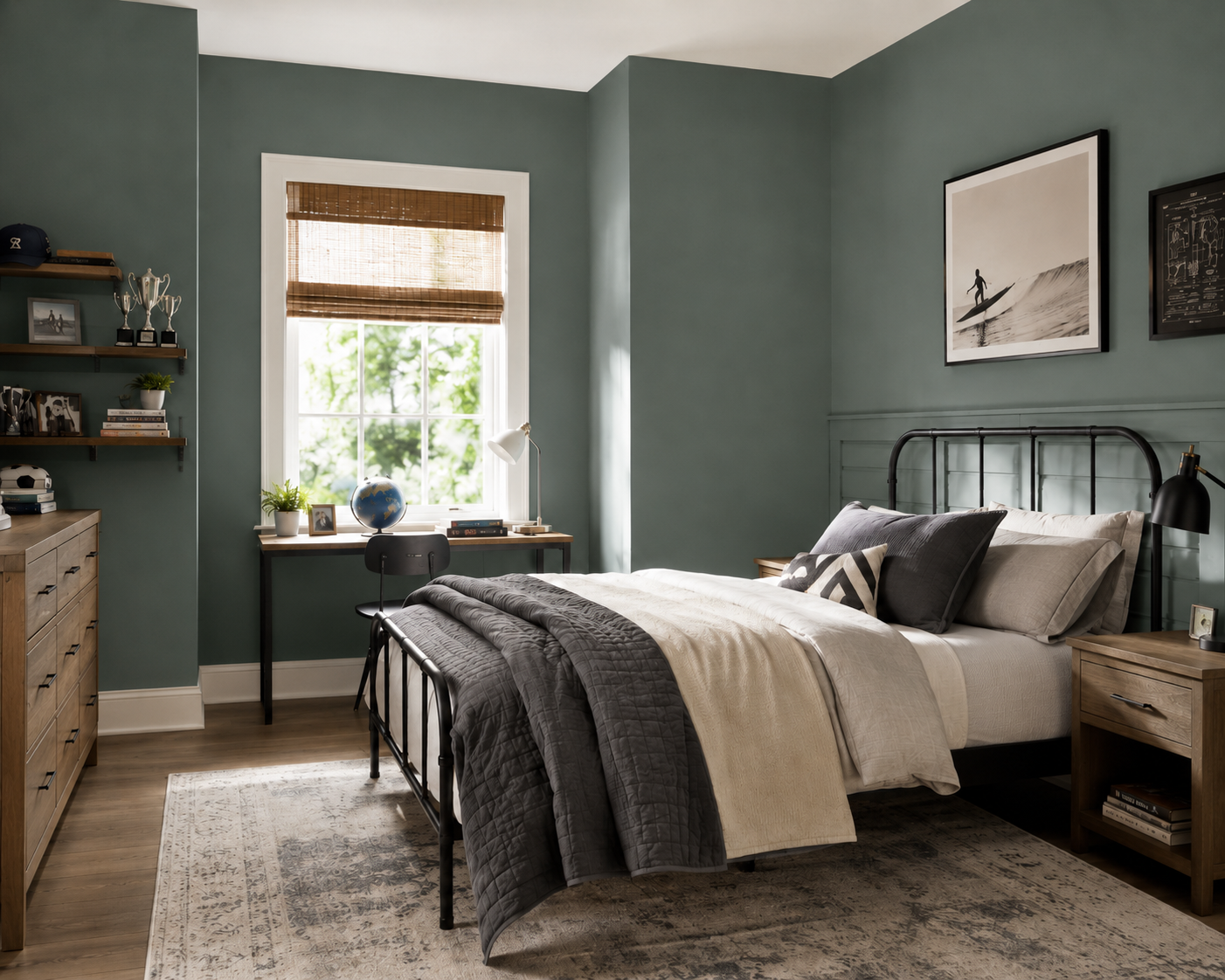
Boy's Bedroom Painted with Behr Hidden Gem N430-6A
Which Green Paint Colors Work in a Boy’s Bedroom?
Green is one of the most versatile choices for 2026. It can feel outdoorsy, traditional, modern, academic, or coastal depending on the undertone and surrounding materials.
Behr Hidden Gem N430-6A is a smoky jade with enough depth to create a defined room. For a lighter and more muted option, Benjamin Moore Raindance 1572 is a steely green with gray undertones.
- Soft sage or jade: Works as a calm full-room color.
- Steely green: Pairs well with black, navy, cognac, and medium-toned wood.
- Deep blue-green: Creates a dramatic backdrop for bookshelves or a bed wall.
- Wasabi or chartreuse: Works better as a limited accent than as a four-wall color.
Muted greens also connect naturally with Southeastern North Carolina’s marsh grasses, live oaks, pine trees, and coastal vegetation. They can give a bedroom a regional character without relying on literal beach décor.
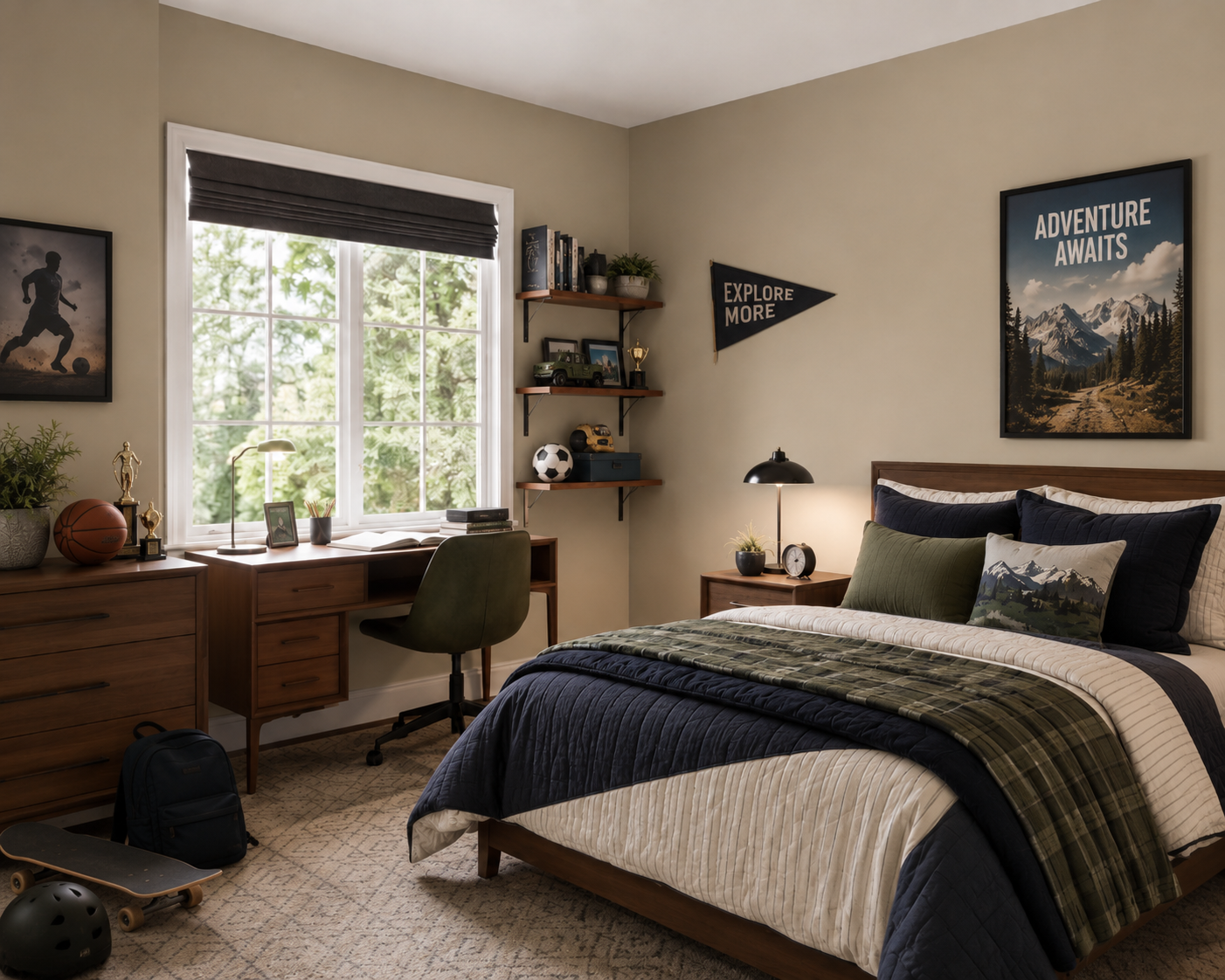
Boy's Bedroom Painted with Sherwin-Williams Universal Khaki SW 6150
How Can Warm Khaki Make a Boy’s Bedroom Easier to Update?
Warm khaki is a useful alternative to cool gray or beige. It provides a neutral foundation, but it has enough warmth and depth to keep the room from feeling unfinished.
Sherwin-Williams Universal Khaki SW 6150 has a slight yellow undertone. It can be paired with navy, forest green, dark brown, muted red, black, cream, or stronger 2026 accents such as Persimmon.
- Use warm khaki when bedding and accessories change frequently.
- Pair it with cream rather than stark blue-white trim for a softer effect.
- Add contrast through a dark ceiling fan, black frames, or stained furniture.
- Use natural fibers such as jute, cotton, canvas, and woven shades to add texture.
Khaki is particularly practical in a bedroom that may eventually become a guest room, office, hobby room, or resale-ready secondary bedroom. For more ideas about creating flexible spaces, read How to Design a Home That Grows with Your Family.
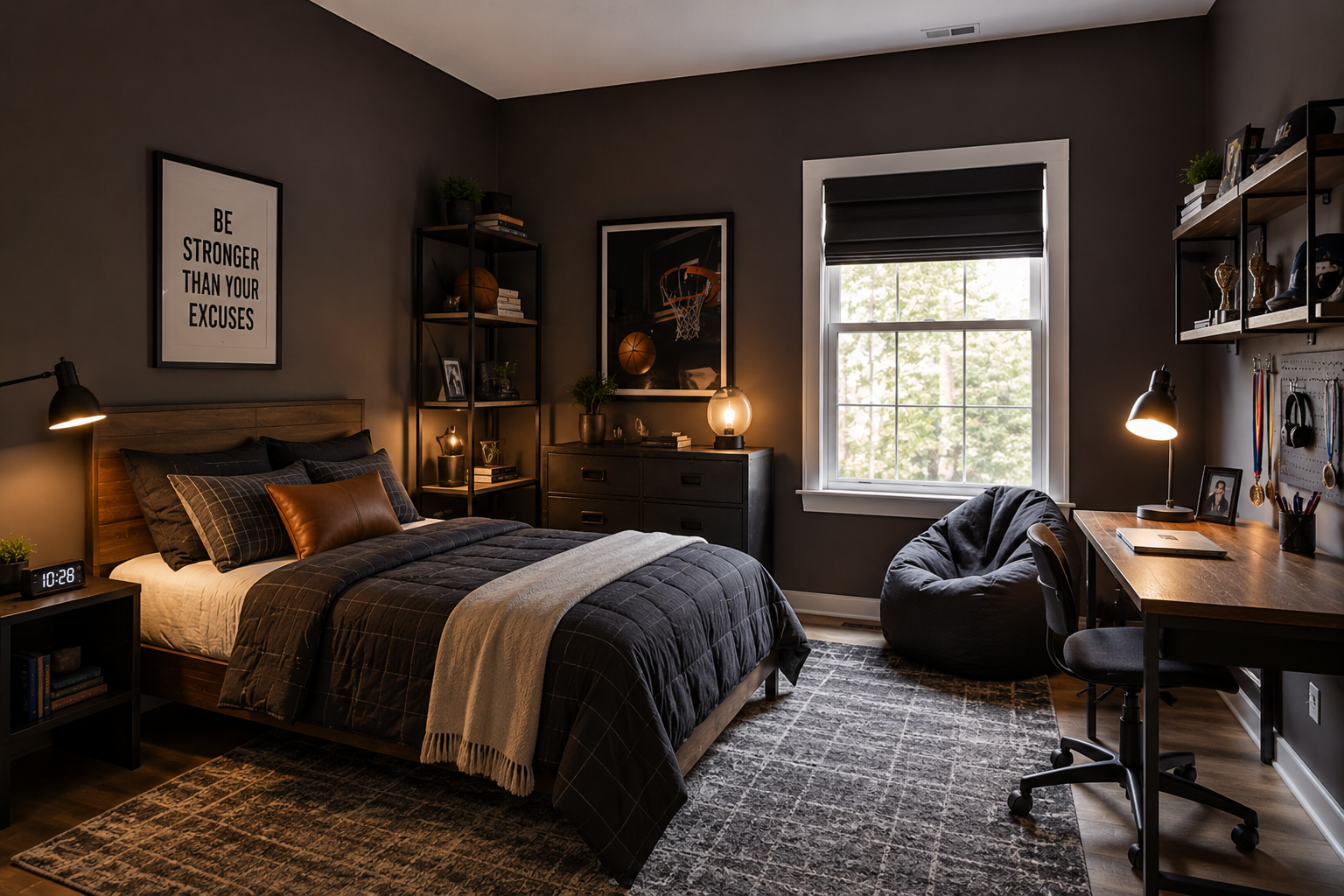
Boy's Bedroom Painted with Benjamin Moore Silhouette AF-655
Can Dark Brown or Charcoal Work in a Small Bedroom?
Dark paint does not automatically make a bedroom look smaller. It reduces contrast between corners and can make the room feel more cohesive, especially when the same color continues onto trim, doors, built-ins, or the ceiling.
Benjamin Moore Silhouette AF-655 combines espresso brown with charcoal notes. In a boy’s bedroom, it can create a sophisticated backdrop for natural wood, camel leather, warm white bedding, olive green, or muted blue.
- Use dark brown behind the bed for a contained focal wall.
- Paint built-in shelves or a desk area for a more limited application.
- Color-drench the room when a cozy, enveloping effect is preferred.
- Balance the walls with layered lighting rather than relying on one ceiling fixture.
Dark paint tends to show drywall imperfections, roller marks, and uneven patching more clearly when light travels across the wall. Proper surface preparation is essential, particularly in rooms with large windows.
Boy's Bedroom Painted with Benjamin Moore Swiss Coffee OC-45
What Is the Best White for a Boy’s Bedroom?
Stark white can appear harsh in a bedroom, especially when it is paired with cool LED lighting. Warm whites and soft off-whites are generally easier to combine with wood furniture, woven materials, colorful bedding, and changing décor.
Benjamin Moore included Swiss Coffee OC-45 in its 2026 Color Trends palette. A warm off-white can serve as the main wall color while stronger shades appear on the ceiling, trim, closet doors, furniture, or one painted shape.
- Choose a creamy white for rooms with cool northern light.
- Compare the wall sample directly with the existing trim.
- Avoid pairing a yellow-leaning white with very cool gray flooring without testing it first.
- Use a washable finish because pale walls show fingerprints and scuffs more readily.
Which Bright Colors Should Be Used as Accents?
Strong colors are returning in 2026, but they do not have to cover an entire room. Pinterest’s Wasabi and Persimmon are useful examples of high-energy colors that can make a simple bedroom feel more personal.
- Persimmon: Use on a desk, closet door, horizontal stripe, or painted arch.
- Wasabi: Add through a narrow border, small geometric shape, or furniture accent.
- Cobalt: Use for shelving, a reading corner, or the lower portion of a two-tone wall.
- Mustard: Pair with navy, green, brown, or warm white.
- Muted red: Add warmth without the intensity of a bright fire-engine red.
For a deeper look at the year’s major colors, see Pinterest’s 2026 Color Trends for Home Décor.
Which Boys’ Bedroom Paint Technique Is Most Popular in 2026?
Gradient walls are one of the most distinctive paint developments of 2026, while color drenching remains a major influence. Other practical techniques include tonal blocking, painted ceilings, two-tone walls, and oversized geometric features.
The right technique depends on the room’s architecture, the desired level of contrast, and how easily the design may need to change later.
What Is Color Drenching?
Color drenching means applying one color, or closely related versions of that color, across several surfaces. Walls, doors, trim, built-ins, and sometimes the ceiling are visually connected instead of being separated by bright white borders.
- Use one finish on walls and a more durable sheen on trim.
- Choose a light or mid-tone color for a softer result.
- Use a dark shade when the goal is a cocoon-like bedroom.
- Repeat the wall color on closet doors to reduce visual clutter.
This technique can be useful in a small bedroom because it reduces abrupt visual breaks. It also makes mismatched doors, trim, or built-ins feel more intentional.
Color Drenched Boy's Bedroom
How Do Gradient Walls Work?
A 2026 gradient wall is more structured than the blended ombré walls common in the early 2010s. Instead of creating a fuzzy transition, homeowners can use three or four related shades on defined architectural sections.
- Place the darkest color on the lower wall and the lightest near the ceiling.
- Use chair rail, picture molding, paneling, or trim as a transition point.
- Choose shades with matching undertones.
- Repeat one gradient color in bedding or artwork to connect the room.
A blue gradient might move from deep navy at the base to muted blue-gray and then to pale blue near the ceiling. A green version could progress from deep blue-green to jade and then soft sage.
Gradient designs require careful planning. Order samples first, arrange them vertically, and confirm that each transition is visible without appearing disconnected.
Should the Ceiling Be Painted a Color?
The ceiling is often the largest uninterrupted surface in a bedroom, yet it is frequently ignored. Painting it can create a finished appearance without adding more furniture or accessories.
- Use a pale blue ceiling with warm white walls for a light, open feeling.
- Repeat the wall color on the ceiling for complete color drenching.
- Choose a darker ceiling in a room with sufficient height and layered lighting.
- Use a flat ceiling paint unless the product instructions recommend another finish.
A painted ceiling can also help a room with minimal architectural detail feel more intentional. It works particularly well when the walls remain neutral.
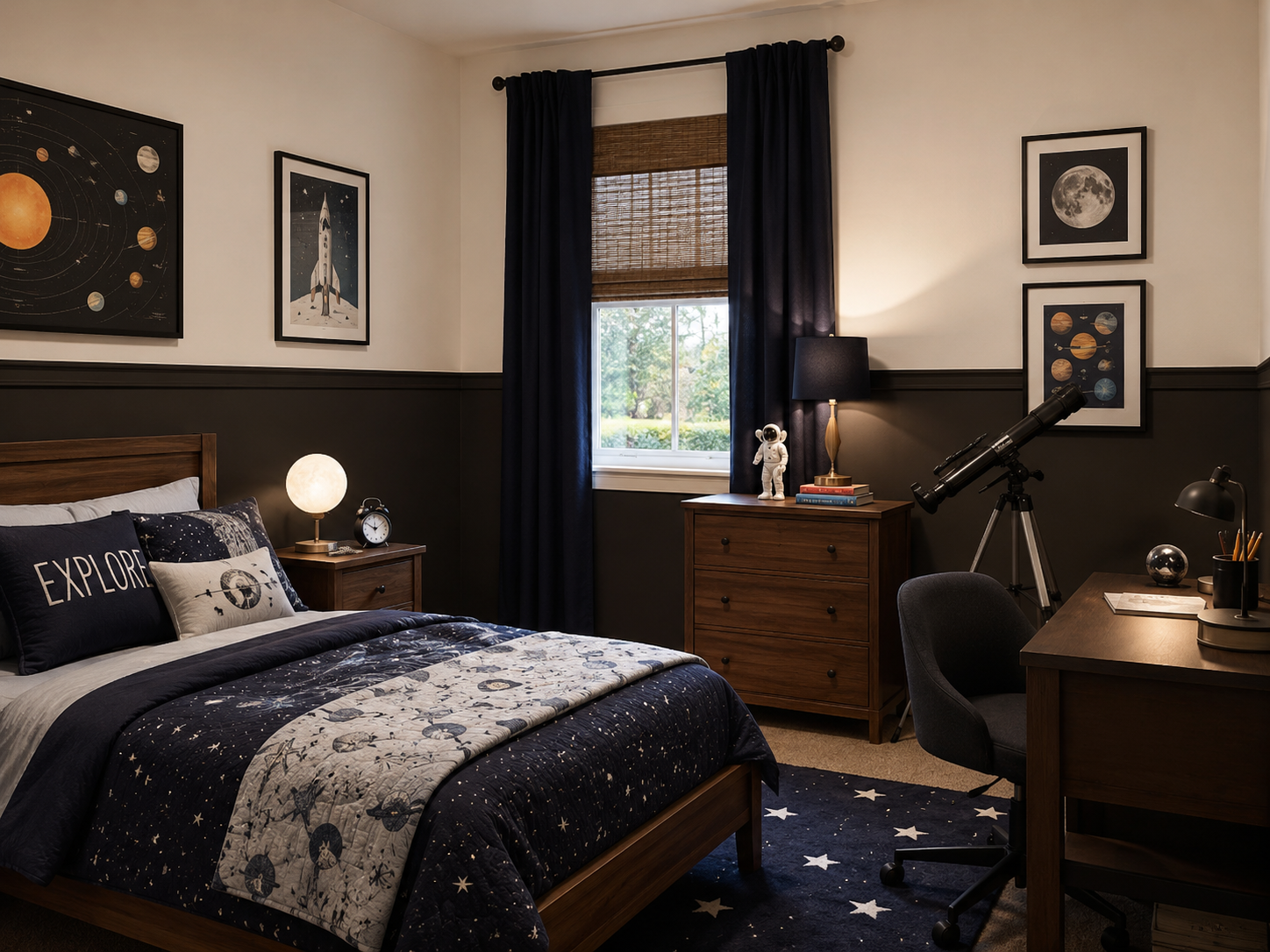
Space Themed Two-Tone Boy's Bedroom
Are Two-Tone Walls Still Current?
Two-tone walls remain practical because they allow homeowners to combine a stronger color with a quieter one. The updated approach uses colors with related undertones rather than a sharp, arbitrary division.
- Paint the lower third or lower half in the darker color.
- Use picture-frame molding, a chair rail, or a crisp taped line as the division.
- Consider painting the lower wall and trim the same color.
- Use the darker portion in areas more likely to show marks.
Popular combinations include khaki with cream, jade with warm white, navy with pale blue, espresso with tan, and muted blue-green with light gray-green.
How Can Geometric Paint Look Sophisticated Instead of Childish?
Geometric paint works best when the design uses a limited palette and an intentional scale. Several small, unrelated shapes can create visual clutter, while one oversized shape can function like architectural detail.
- Paint one large circle behind a reading chair or dresser.
- Create a wide arch behind the bed as a painted headboard.
- Use broad diagonal blocks in two closely related colors.
- Repeat colors already present in the flooring, furniture, or bedding.
- Limit the design to two or three paint colors.
Use quality painter’s tape designed for the existing surface. ScotchBlue Original Multi-Surface Painter’s Tape, for example, is intended for smooth or lightly textured walls, trim, tile, and glass. Always follow the manufacturer’s application and removal instructions.
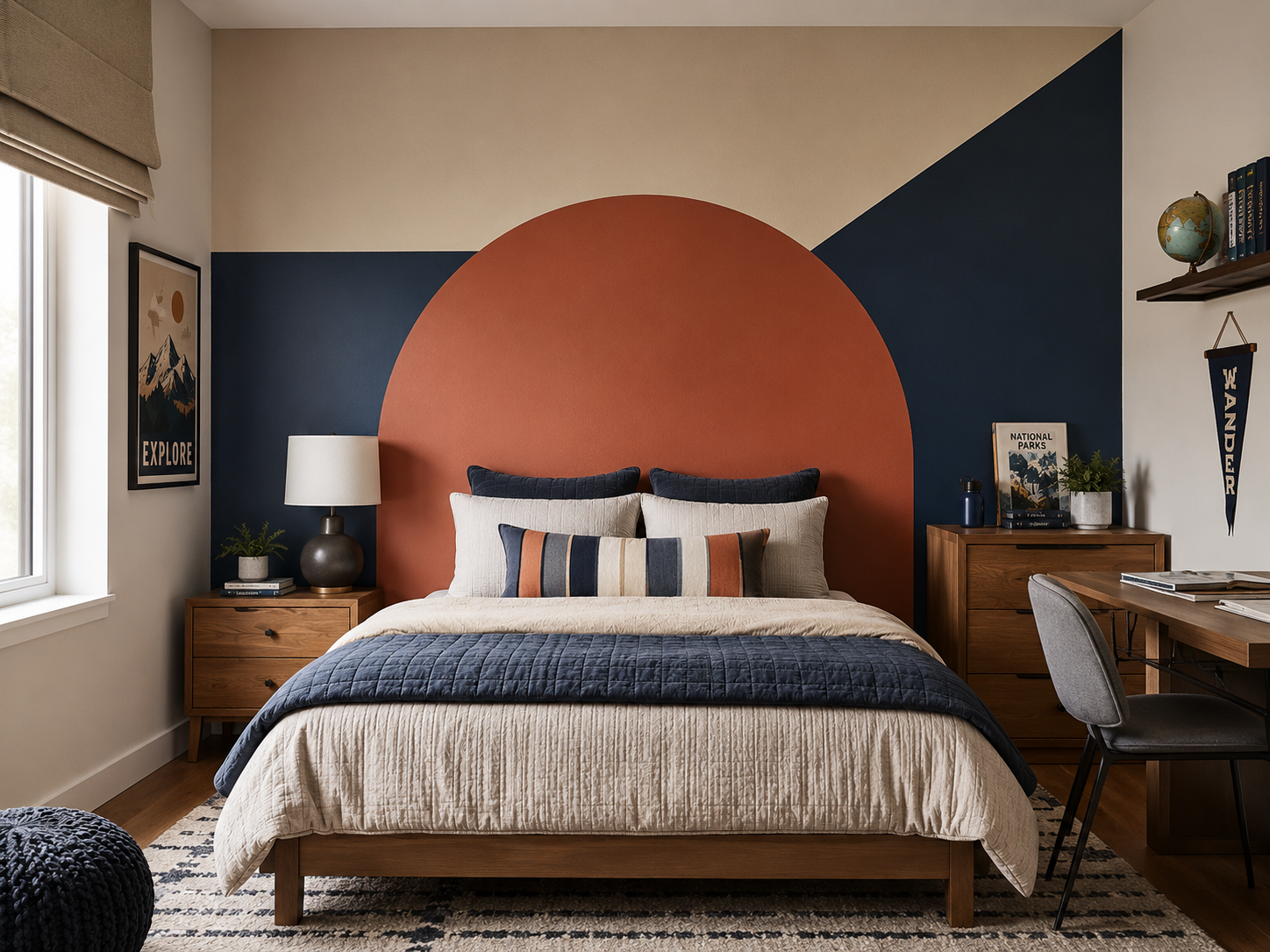
Painted Geometric Headboard in Boy's Bedroom
Are Stripes a Good Long-Term Bedroom Design?
Stripes can be timeless when their scale and contrast are controlled. Wide tonal stripes usually age better than narrow stripes in several bright colors.
- Use vertical stripes to emphasize ceiling height.
- Use one broad horizontal stripe to connect furniture across a wall.
- Choose two shades from the same paint strip for a subtle effect.
- Paint only one wall when the pattern has strong contrast.
Stripes require careful measuring. Start from the room’s focal point rather than assuming the corner is perfectly straight, because walls and ceilings are not always square.
How Should Paint Colors Change as a Boy Gets Older?
A bedroom does not have to be repainted every time interests change. The most adaptable rooms separate long-lasting finishes from short-term decorative choices.
What Works for a Younger Boy’s Bedroom?
- Use a light or mid-tone base color that keeps the room bright.
- Add stronger color through a painted arch, stripe, door, or furniture piece.
- Leave room for artwork, collections, books, and changing interests.
- Select a finish that can tolerate routine cleaning.
What Works for a Preteen Bedroom?
- Use muted green, blue-gray, khaki, or warm white as the foundation.
- Create a defined desk, gaming, reading, or hobby area with paint.
- Replace literal themes with colors and textures connected to those interests.
- Add corkboard, magnetic boards, shelving, or display rails without covering every wall.
What Works for a Teen Boy’s Bedroom?
- Consider deeper colors such as navy, smoky jade, espresso, charcoal, or blue-green.
- Use color drenching for a more mature and cohesive appearance.
- Balance darker walls with task lighting and warm ambient lighting.
- Choose flexible furniture and storage rather than permanent themed murals.
A teen bedroom does not have to be gray to feel mature. Deep green, brown, plum, blue, and rust can create a sophisticated result while still allowing individuality.
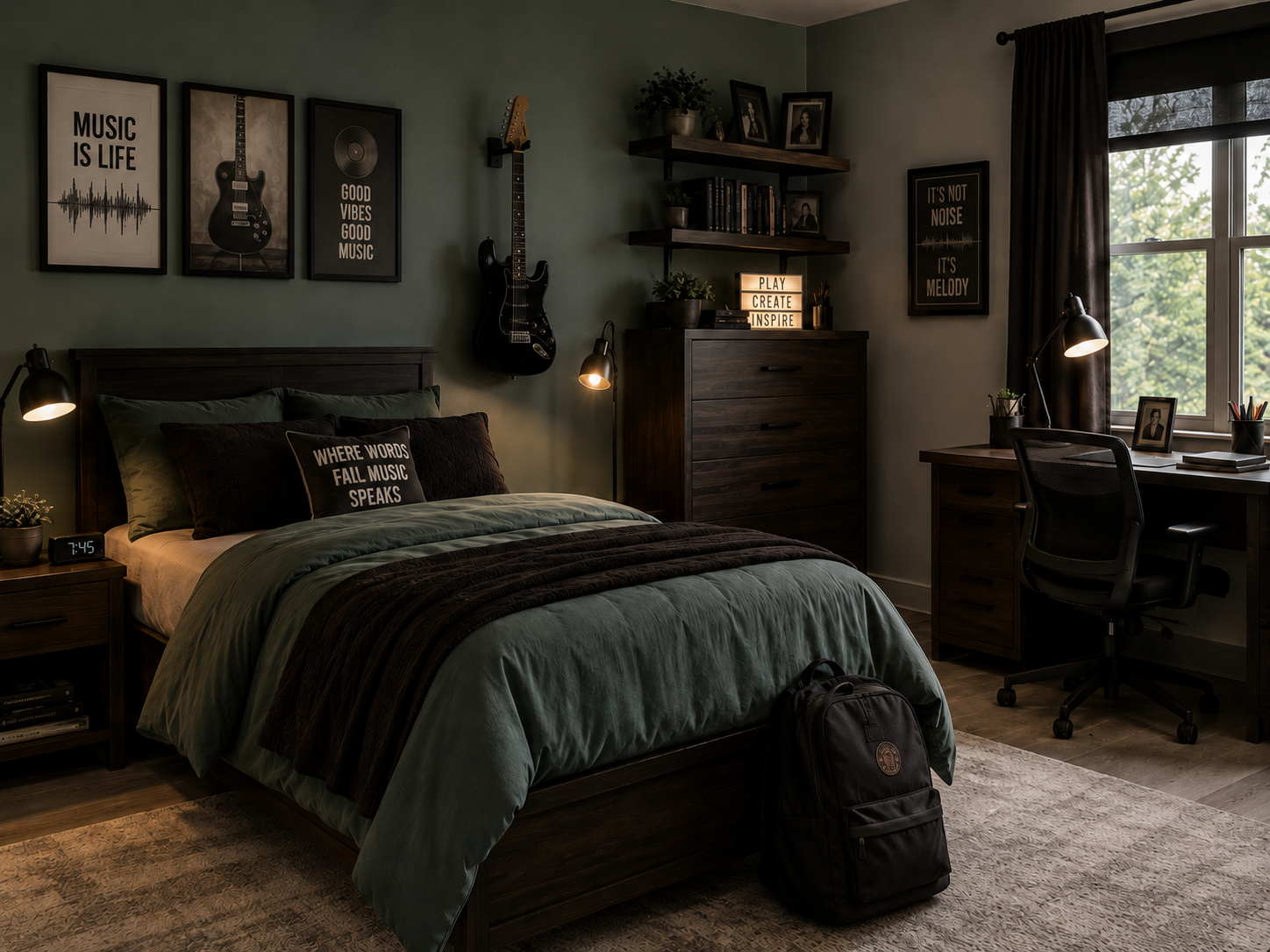
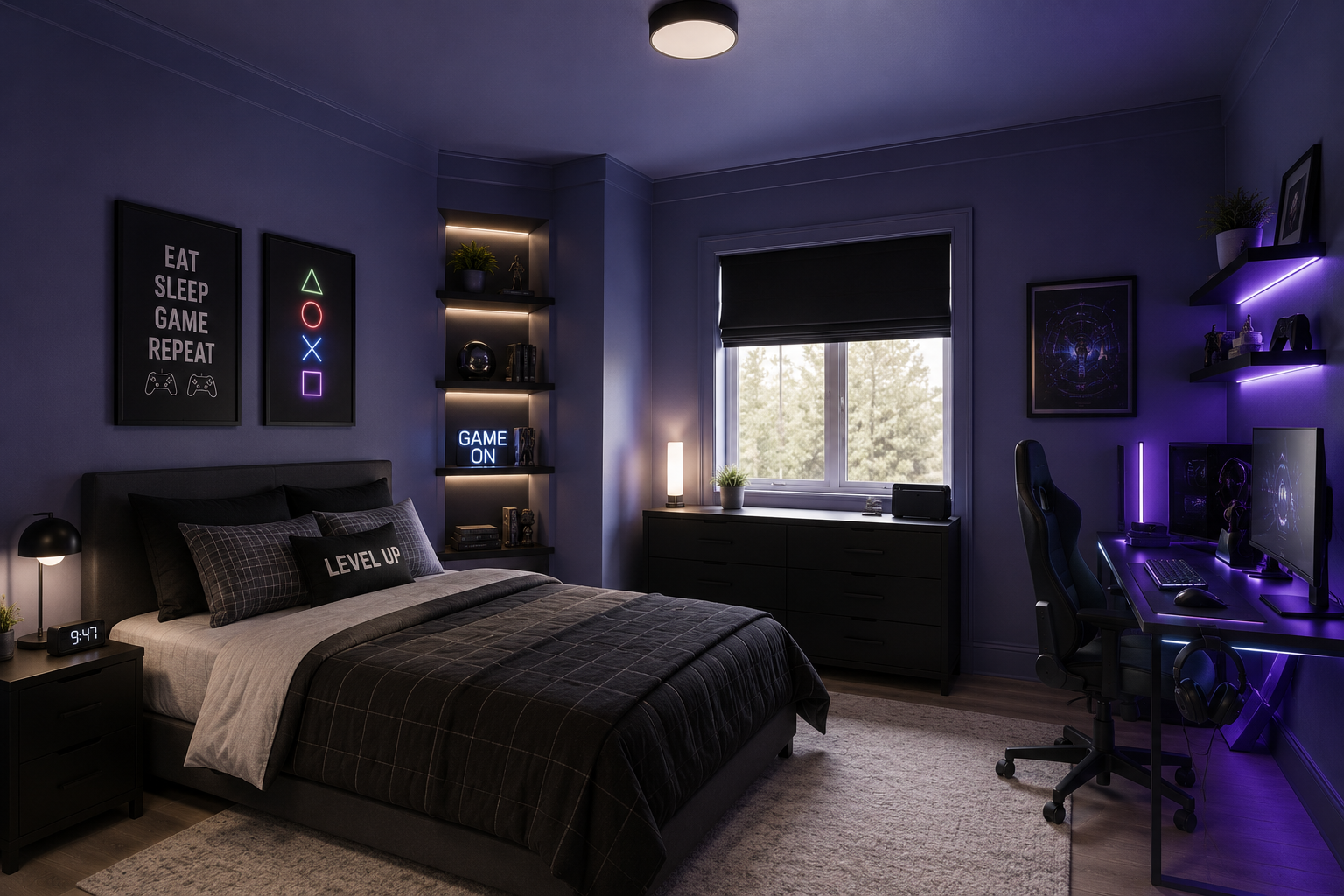
Teen Boy's Bedroom - Music Themed
How Does Natural Light Affect Bedroom Paint in Wilmington?
Paint color is influenced by window direction, time of day, flooring, nearby trees, exterior overhangs, and artificial lighting. A color viewed online or under store lighting may look noticeably different once it covers a bedroom wall.
Bright coastal sunlight can make pale colors appear lighter and can reveal undertones that were not obvious on a small chip. Rooms shaded by porches, mature trees, or neighboring structures may need a warmer or clearer color to keep the space from looking dull.
- North-facing rooms: Often benefit from warmer whites, khakis, green-grays, and softened blues.
- South-facing rooms: Can usually support cooler blues, deeper greens, and darker feature colors.
- East-facing rooms: Receive brighter morning light and become more subdued later in the day.
- West-facing rooms: May become much warmer and more saturated in late-afternoon light.
Test every serious contender on more than one wall. Benjamin Moore recommends evaluating samples as lighting changes; its 8-ounce brush-on color samples can cover an approximately 2-foot-by-2-foot test area. Sherwin-Williams also offers color chips and peel-and-stick samples.
What Paint Finish Is Best for a Boy’s Bedroom?
Sheen describes how much light the dried paint reflects. Higher-sheen paints are generally more reflective, while flatter finishes absorb more light and can help disguise minor surface irregularities.
- Flat: Low reflection and useful for ceilings, but standard flat products may be less resistant to repeated cleaning.
- Matte: Provides a soft appearance; premium washable matte paints can be practical for bedrooms.
- Eggshell: Offers a slight sheen and is a common choice for walls that need occasional wiping.
- Satin: More reflective and often useful for doors, trim, furniture, and high-contact surfaces.
- Semi-gloss: Durable and easy to clean, but it highlights surface imperfections.
Product performance varies by manufacturer, so do not select paint based on sheen name alone. Review the product’s washability, scuff resistance, recommended surfaces, recoat time, and curing instructions.
Benjamin Moore Aura Interior, for example, is offered in multiple finishes and is designed for rich color and durable results. Other major manufacturers offer comparable premium washable products.
How Do You Prepare a Bedroom for Painting?
Good preparation matters as much as color selection. Dark shades, high-contrast designs, and painted ceilings are especially unforgiving when walls have unpatched holes, rough repairs, dust, or inconsistent texture.
- Empty or consolidate the room. Remove smaller items and move remaining furniture away from the walls.
- Protect the floor. Use a secured canvas drop cloth or another covering appropriate for the flooring.
- Clean the walls. Remove dust, residue, and marks that could interfere with adhesion.
- Patch damage. Fill nail holes, dents, and cracks with the correct repair compound.
- Sand repairs smoothly. Feather the edges so patches do not show through the new paint.
- Prime where needed. Prime bare drywall, repaired areas, stains, and major color changes according to product directions.
- Tape carefully. Use tape appropriate for the surface and do not leave it in place longer than recommended.
- Cut in and roll consistently. Maintain a wet edge to reduce lap marks.
- Allow proper drying and curing. Dry-to-touch, recoat, and full-cure times are not the same.
- Ventilate the room. Follow all label precautions and keep air moving appropriately during and after painting.
A quality angled brush can make trim, corners, and geometric details easier to control. One example is the Wooster Pro Nylon/Polyester Thin Angle Sash Brush.
Should Homeowners Choose Low-VOC or Zero-VOC Paint?
VOC stands for volatile organic compound. These compounds can evaporate into the air from paint and other household products. The U.S. Environmental Protection Agency recommends increasing ventilation when using products that emit VOCs and following all label precautions.
Low-VOC or zero-VOC paints may help reduce the indoor pollution load, but VOC content is not the only performance consideration. Homeowners should also evaluate durability, overall composition, coverage, and the manufacturer’s intended use.
- Open windows when weather and safety conditions allow.
- Use fans without directing dust onto wet paint.
- Follow the manufacturer’s occupancy and ventilation guidance.
- Do not store partially open paint containers in occupied rooms.
Additional guidance is available through the EPA’s information on volatile organic compounds and indoor air quality.
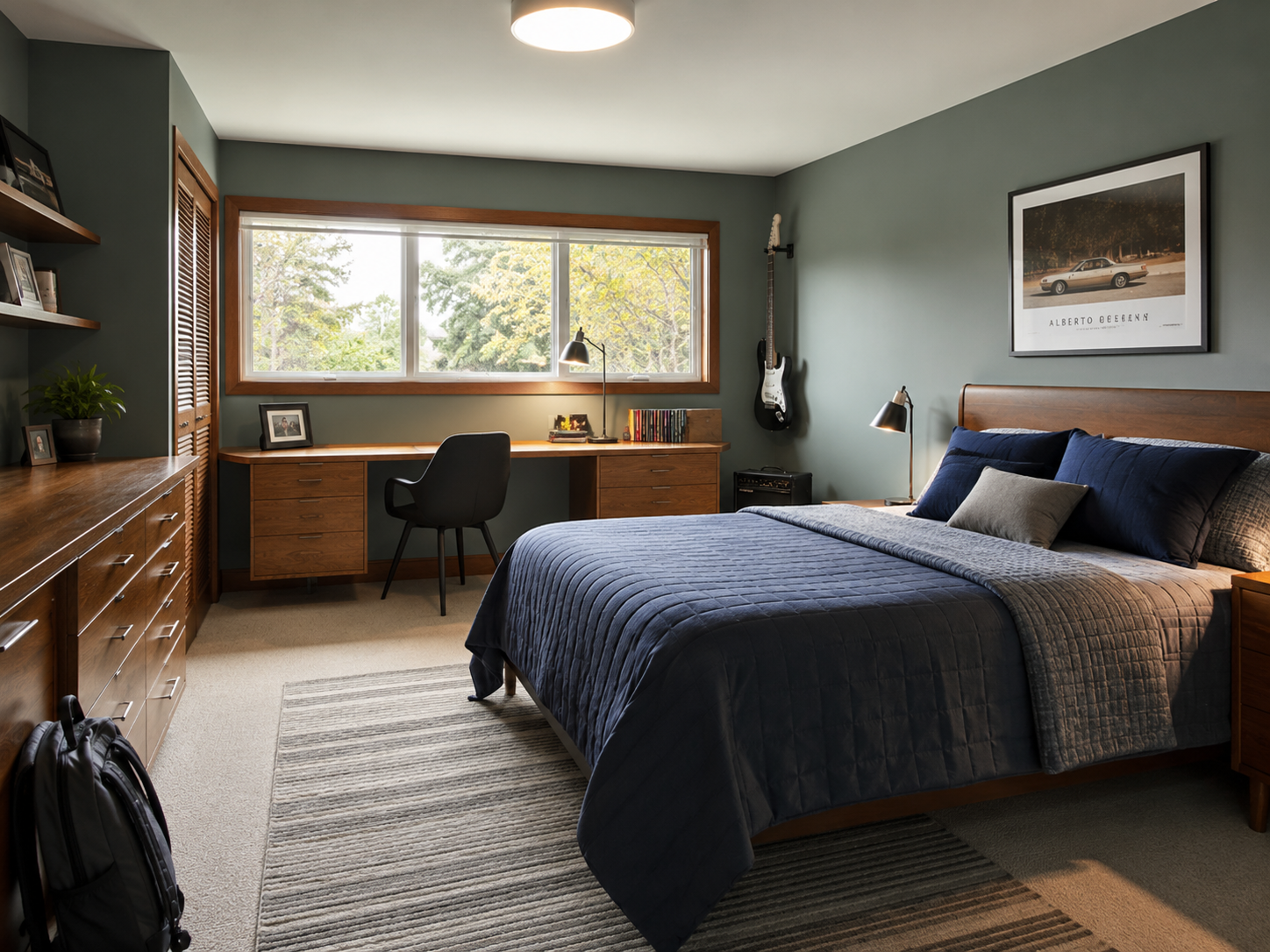
Updated 1960s Bedroom for Teen Boy
What Should Owners of Older Wilmington Homes Know About Lead Paint?
Homes built before 1978 are more likely to contain lead-based paint because the federal government banned consumer uses of lead-based paint in 1978. Sanding, scraping, drilling, or otherwise disturbing painted surfaces can create hazardous dust when lead paint is present.
- Determine the home’s construction year before beginning disruptive preparation.
- Do not dry-sand or aggressively scrape a questionable surface without proper testing and precautions.
- Consider hiring a certified lead inspector, risk assessor, or lead-safe contractor.
- Keep the work area contained and follow current EPA guidance.
The EPA provides specific information about lead-safe renovations for do-it-yourself projects. This is particularly relevant in Wilmington, where buyers may encounter homes built during many different construction periods.
How Can a Boys’ Bedroom Feel Coastal Without Looking Themed?
Coastal design does not require literal beach imagery. A more flexible approach uses color, texture, light, and materials associated with the region.
- Use pale blue, smoky green, marsh-inspired jade, warm white, sand, or driftwood brown.
- Add white oak, medium-toned wood, cane, rattan, canvas, cotton, and woven shades.
- Choose striped textiles carefully rather than painting the entire room in nautical colors.
- Use local landscape photography, maps, or abstract artwork instead of mass-produced beach signs.
- Balance cool wall colors with warmer natural materials.
This approach feels appropriate for Wilmington, Wrightsville Beach, Carolina Beach, Hampstead, Leland, and other Southeastern North Carolina communities without limiting the bedroom to one theme.
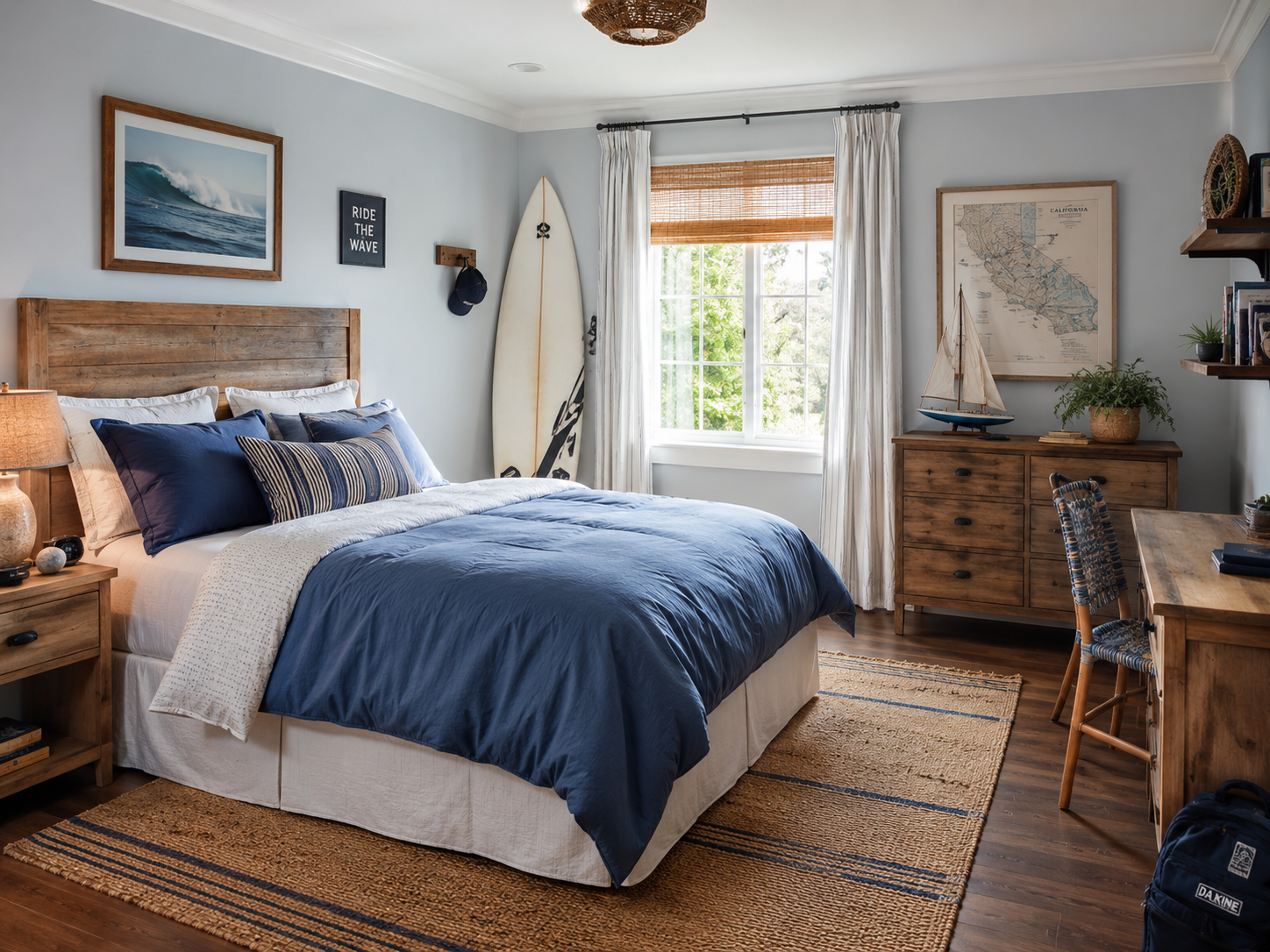
Boy's Coastal Bedroom
Can Bedroom Paint Choices Affect Resale Appeal?
Paint color alone does not determine market value, and no single bedroom color guarantees a higher sale price. However, paint condition, visual consistency, room photography, and the amount of work a buyer expects to complete can influence overall presentation.
The Cameron Team has helped Wilmington-area buyers and sellers since 1994. Through that experience, we have seen how clean walls, repaired damage, coordinated colors, and well-lit rooms can help a property appear better maintained and easier to personalize.
- Use broadly adaptable colors when a sale is expected soon.
- Repair patches, nail holes, stains, and peeling paint before listing.
- Repaint highly personalized murals or complicated multicolor designs when they dominate the room.
- Keep bold 2026 colors on limited surfaces if resale flexibility is a priority.
- Make sure the paint photographs accurately under the room’s lighting.
Cool Blue, jade, khaki, warm white, and muted blue-gray are generally easier to style for listing photos than neon colors or high-contrast patterns. Dark colors can still work when the room has adequate light and the finish is professionally applied.
For more guidance, read The Psychology of Color in Home Design and How It Affects Buyers.
What Are the Most Common Boys’ Bedroom Paint Mistakes?
Misconception: A Boy’s Bedroom Has to Be Blue
Blue is only one option. Green, brown, khaki, cream, rust, plum, gray-green, and warm white can all create attractive boys’ bedrooms. The best color reflects the occupant’s preferences, the room’s light, and the materials already present.
Misconception: Dark Paint Always Makes a Room Look Smaller
Dark paint can make a room feel more enclosed, but that is not always negative. When walls, trim, and doors share a similar color, reduced contrast can create visual continuity. Lighting and furniture scale often have as much influence on perceived size as paint color.
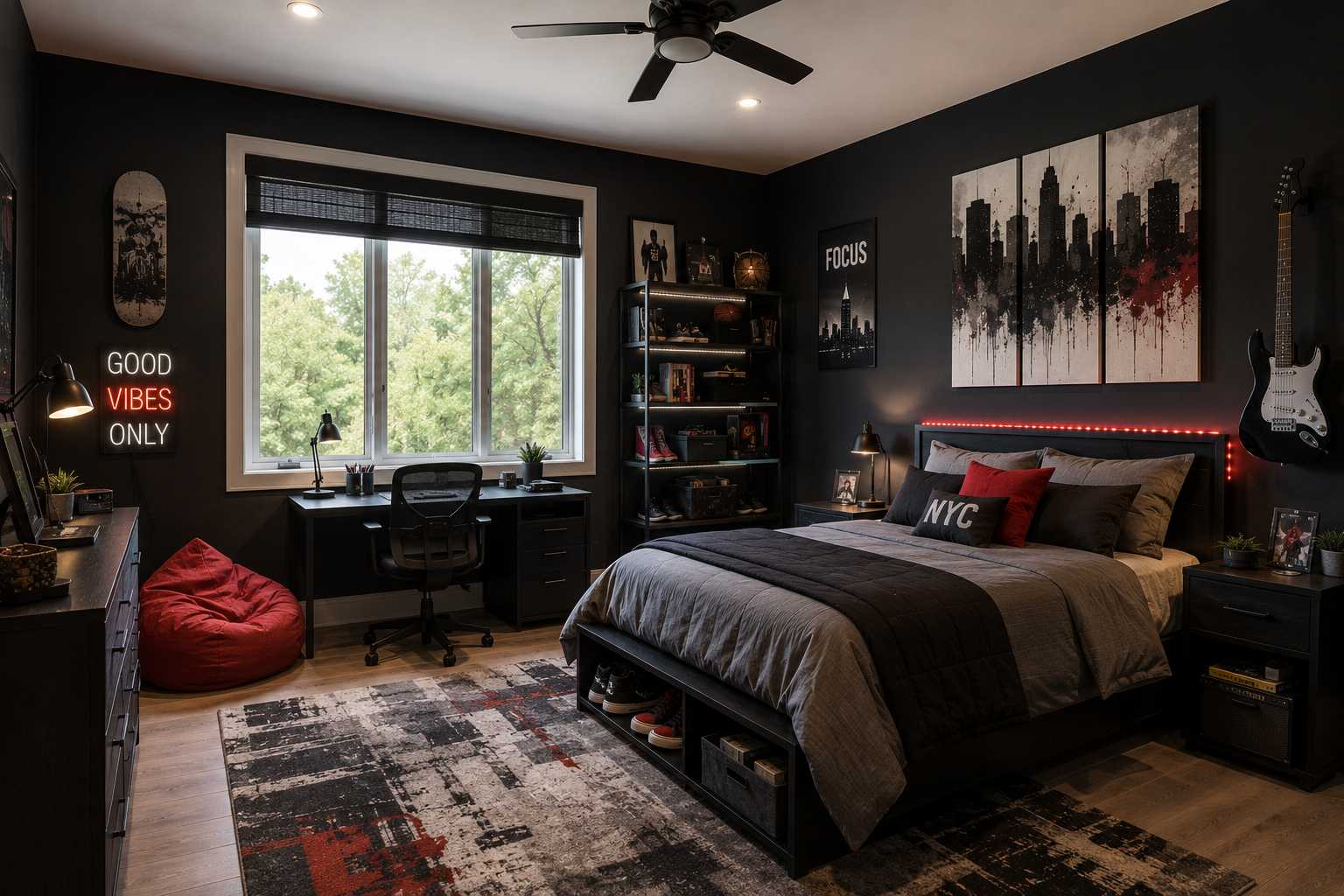
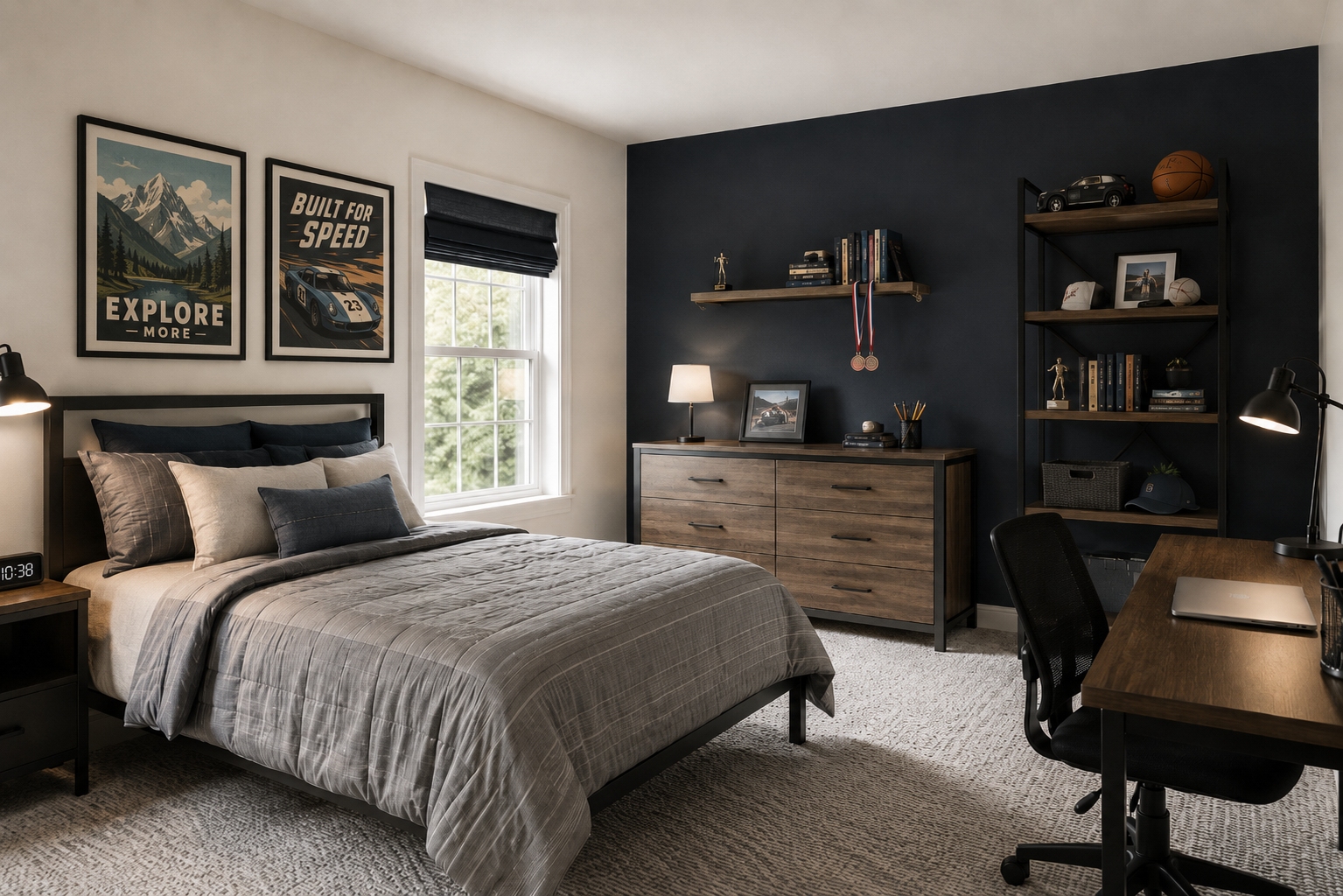
Urban Teen Boy's Bedroom with Dark Walls
Misconception: Every Bedroom Needs an Accent Wall
An accent wall should have a clear purpose, such as emphasizing the bed, shelves, architecture, or a work area. Painting one random wall a different color can make the room feel unbalanced. Color drenching, a painted ceiling, or tonal blocking may provide a more cohesive alternative.
Misconception: A Digital Image Is Enough to Choose Paint
Computer screens and phones cannot reproduce paint color perfectly. Screen settings, photography, editing, and ambient light change what the viewer sees. Always test a physical sample in the room before purchasing several gallons.
Misconception: Flat Paint Is Always Best for Hiding Imperfections
Low-sheen paint can reduce reflection, but it cannot conceal poor patching, uneven texture, or peeling surfaces. Proper preparation remains necessary. Some standard flat paints are also less suitable for walls that need frequent cleaning, although premium washable matte products may perform differently.
What Products Are Useful for a Boys’ Bedroom Painting Project?
The following links can help with color research, sampling, surface preparation, and application. Product availability, specifications, and pricing can change, so review current manufacturer information before purchasing.
- Sherwin-Williams Universal Khaki SW 6150: A warm, adaptable 2026 neutral.
- Benjamin Moore Color Trends 2026: Includes Silhouette, Raindance, Swiss Coffee, Narragansett Green, and other coordinated colors.
- Behr Hidden Gem N430-6A: A smoky blue-green selected as Behr’s 2026 Color of the Year.
- Benjamin Moore Brush-On Color Sample: Useful for evaluating color under changing light.
- Sherwin-Williams Color Samples: Color chips, peel-and-stick samples, and other testing options.
- ScotchBlue Original Painter’s Tape: Designed for smooth or lightly textured surfaces, trim, tile, and glass.
- Wooster Angled Sash Brush: Useful for cutting in, trim, corners, and painted designs.
- Benjamin Moore Aura Interior Paint: A premium interior line offered in several finishes.
What Other Bedroom and Color Guides Can Help?
- 10 Lovely Paint Colors to Brighten Your Bedroom
- Pinterest’s 2026 Color Trends for Home Décor
- The Psychology of Color in Home Design and How It Affects Buyers
- Bedroom Décor Trends and Refresh Ideas
- How to Design a Home That Grows with Your Family
How Do You Choose the Final Bedroom Color?
Begin with the parts of the room that are not changing. Flooring, furniture, trim, window direction, and permanent fixtures should influence the undertone of the paint.
- Select three to five possible colors.
- Compare their undertones with the flooring and furniture.
- Test the finalists on at least two walls.
- Observe them in morning, afternoon, and nighttime lighting.
- Place bedding and major textiles beside the samples.
- Choose the paint technique only after selecting the base color.
- Confirm the finish, quantity, preparation products, and ventilation plan.
The most successful boys’ bedroom paint ideas for 2026 balance expression with flexibility. A room can be colorful, current, and personal without depending on a temporary theme or a complicated mural.
For Wilmington-area homeowners preparing to sell, The Cameron Team can also provide insight into which updates may improve presentation and which projects may not be necessary. Paint should support the home’s architecture, condition, lighting, and likely buyer expectations rather than follow a trend without context.
Check out this article next