
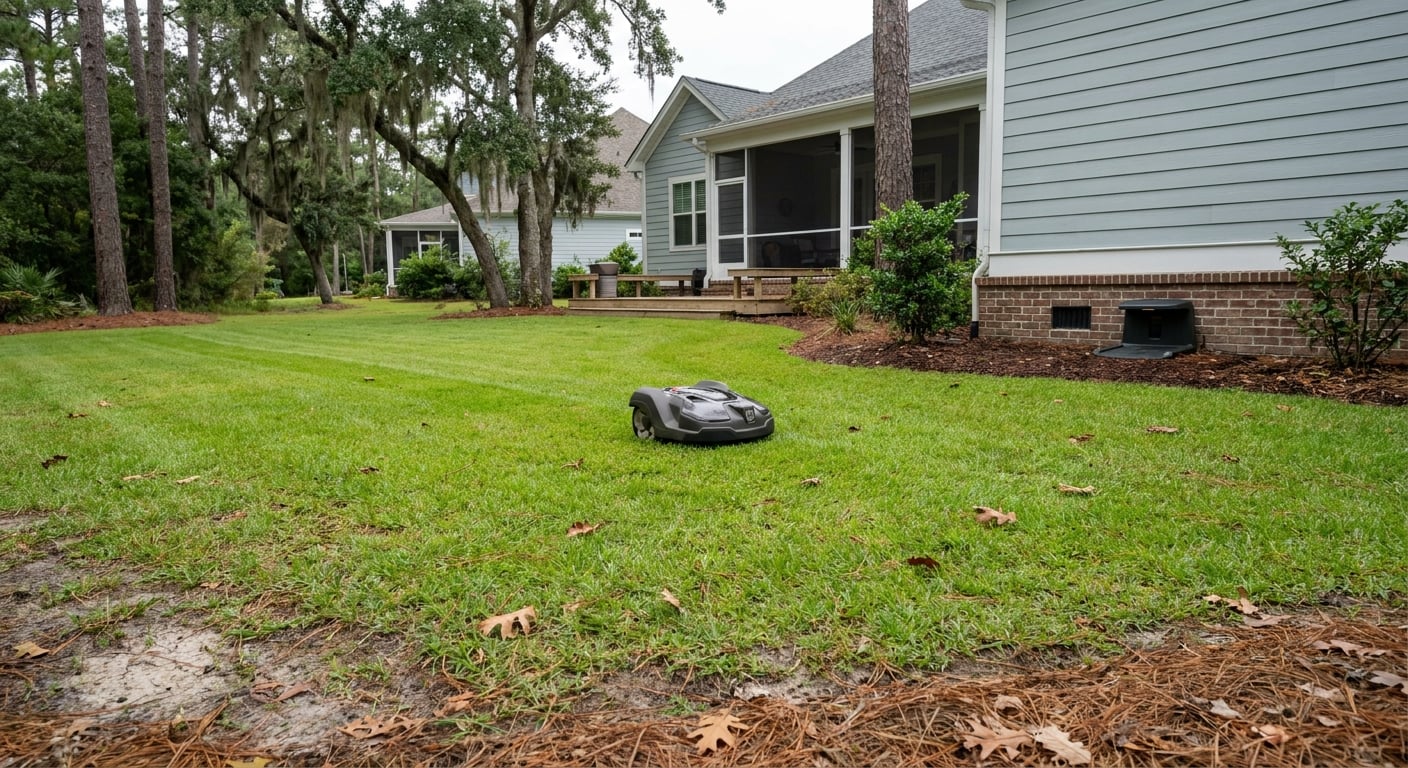
If you've been eyeing a robot mower or just toured a home where one was quietly circling the backyard, you're not alone. These things have gotten genuinely smarter and more affordable over the last couple of years, with entry-level models now starting below $1,000. But "works great" in a flat, open Midwest subdivision and "works great" in a coastal Carolina yard are two very different claims. Around Wilmington and the surrounding counties, yards come with their own set of quirks, and those quirks matter more than the spec sheet.
Key Takeaways
Entry-level robot mowers now start below $1,000, but local yard conditions matter far more than price when deciding if one fits your property.
Wilmington's rainfall, warm-season grasses, sandy or poorly drained soils, tree canopy, and post-storm debris all affect how well these mowers perform.
Your actual mowable area is almost always smaller than your lot size once you subtract the home, beds, pools, drainage areas, and natural buffers.
Ownership costs include blade changes, battery replacement every 2 to 5 years, setup, and continued edging and cleanup.
Robot mowers handle repetitive mowing. They don't replace edging, fertilizing, weed control, or storm cleanup.
Buyers purchasing a home with a robot mower need written confirmation of exactly what conveys, including the charger, base station, and app access.
For sellers, consistent turf maintenance helps before photos and showings, but a robot mower isn't a substitute for full pre-listing prep.
Do Robot Mowers Work in Coastal Carolina Yards?
Honestly, sometimes. And it really comes down to your specific property.
Wilmington and the surrounding coastal counties get around 60 inches of rainfall annually. That's not a minor detail. Most robot mowers pause when it rains, and the aftermath matters just as much: soft ground, pooling near drainage areas, and wheel ruts in grass that hasn't had time to firm up. A mower that works beautifully in dry conditions can leave a mess after a week of summer storms.
The soil here adds another layer. A lot of yards in New Hanover, Brunswick, and Pender Counties sit on Murville-type soils, which can carry a seasonal water table as shallow as a foot below the surface. That yard that looks sandy and well-drained in April can behave completely differently after a stretch of July rain. It affects traction, turf health, and long-term wear in ways you won't read about on a product listing.
Then there's just the reality of living on the coast. Salt spray, windblown sand, pine needles, live oak leaves, and the occasional branch after a storm are all part of the deal here. Robot mowers don't pick up debris. They keep up with grass growth between cleanups, but they're not a yard care solution on their own.

What Yard Features Affect Robot Mower Performance?
Before you fall down a rabbit hole of model comparisons, take an honest look at your actual mowable area, not your lot size. The two are rarely the same.
Subtract your home's footprint, the driveway, any landscaping beds, a pool or patio, natural areas, and drainage easements. If you're near the water or in a low-lying neighborhood, add marsh buffers or retention areas to that list. What's left is what the mower actually has to navigate.
Compact lots in Wilmington, Carolina Beach, or Kure Beach may not leave much room at all. Larger properties in Leland, Hampstead, Bolivia, Rocky Point, or Sneads Ferry often have real acreage to cover, which is where the time-savings argument starts to make more sense.
How Much Tree Cover Does the Yard Have?
This one surprises people more than almost anything else. Newer wire-free robot mowers rely on GPS or RTK positioning to find their way around, and some units need roughly a 135-degree open sky view for the base station to work reliably. Wilmington yards, especially in established neighborhoods, tend to have significant live oak and pine canopy that blocks or weakens that signal.
LiDAR-assisted and vision-based models handle tree cover better, but they cost more. If your yard has heavy canopy near fence lines, rooflines, or tight side passages, it's worth testing the navigation signal in those spots before you commit.
How Level and Connected Is the Lawn?
Most robot mowers manage gentle slopes reasonably well. Steeper grades, exposed roots, swales, and wet low spots are a different story. Beyond terrain, a disconnected yard layout adds real friction. If your front and back lawns are separated by a fence gate or a driveway crossing, the mower needs a path wide enough to move between zones on its own, otherwise you're moving it manually, which defeats part of the point.
Check gate widths, curb drops, and drainage swales before assuming the mower can handle the full property without your help.
Where Can the Charging Station Go?
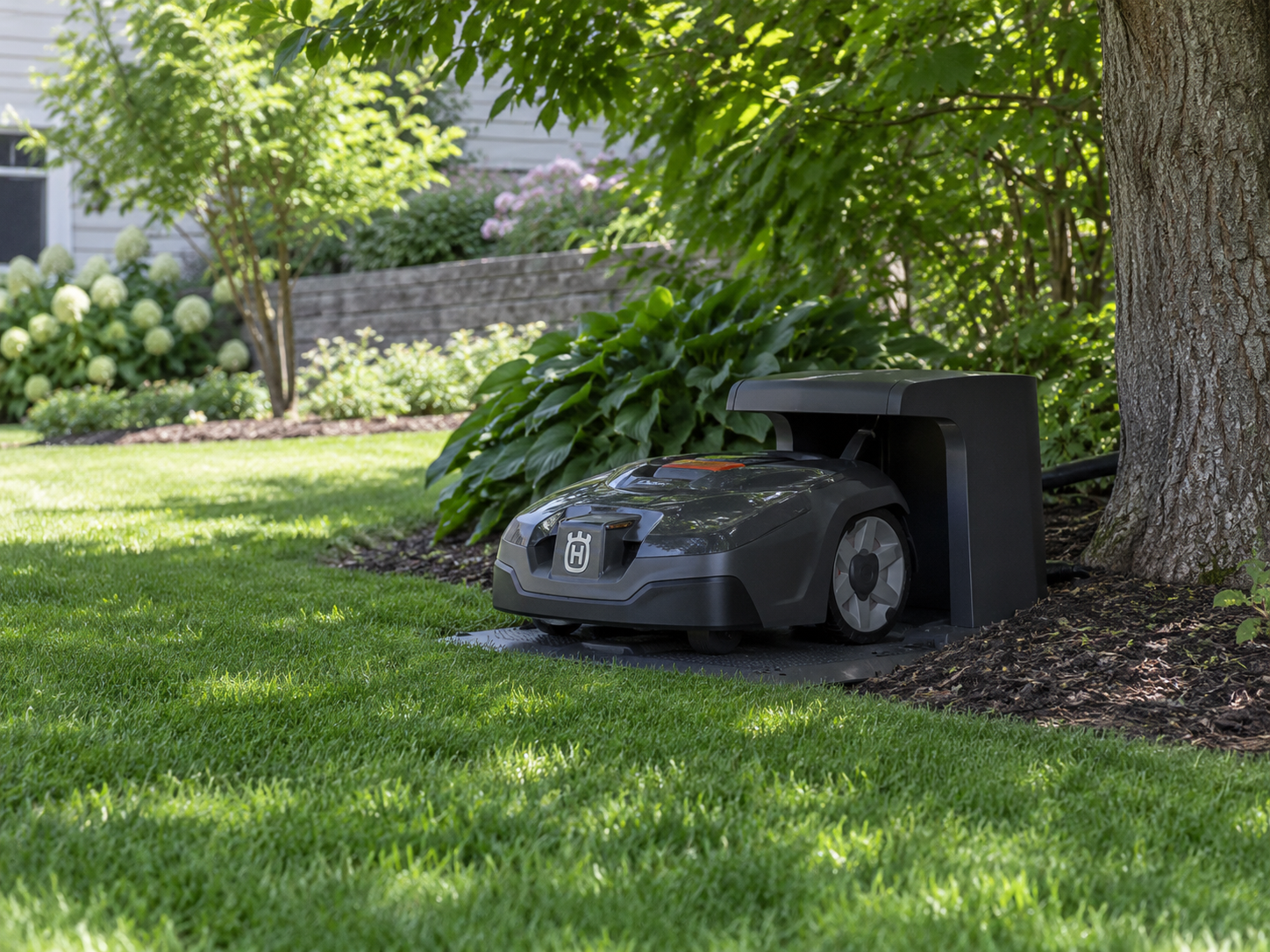
The charging station needs level ground, shade, a nearby GFCI outlet, reliable Wi-Fi or cellular coverage, and easy access to the mowing area. That sounds simple until you start walking your yard and ruling things out. Low spots that collect water, irrigation spray zones, and spots visible from the street (theft is worth thinking about) all take locations off the table.
In flood-prone neighborhoods, placement matters even more. You don't want the station sitting somewhere that takes on water during a heavy storm.
What Grass and Cutting Height Does the Yard Need?
Coastal Carolina lawns are mostly warm-season grasses, and their recommended mowing heights vary more than people expect:
Grass Type | Recommended NC Mowing Height |
|---|---|
Bermuda | 0.75 to 2 inches |
Centipede | 1 to 2 inches |
St. Augustine | 2.5 to 4 inches |
Zoysia | 0.75 to 2 inches |
St. Augustine is common in this region, and it needs to stay taller than most robot mowers are built to cut. NC State Extension's turfgrass guidance is worth a look before you buy, because a mower that can't hold the right height for your grass type will create problems rather than solve them.
What Does a Robot Mower Really Cost to Own?
The purchase price is just the starting point. Here's a realistic look at what you're comparing:
Option | Approximate Cost | What It Doesn't Cover |
|---|---|---|
Robot mower | Setup, blades, battery replacement, edging | |
Lawn service | $55 to $165 per visit locally | Confirm trimming and cleanup are included |
Traditional mower | Equipment plus your time | Fuel or batteries, storage, ongoing maintenance |
Batteries on most robot mowers last roughly 2 to 5 years before they need replacing, and that replacement isn't cheap. Add blade changes, occasional service, and the continued need for edging, fertilizing, weeding, and storm cleanup, and the total cost of ownership looks different than the advertised number.
That doesn't make it a bad purchase. For the right yard and the right household, the time savings are real. Just go in with a clear-eyed number.
What Should Homebuyers Check Before Closing?
If a home you're buying comes with a robot mower, slow down before assuming it's a straightforward bonus. Robot mowers don't automatically convey with a home in North Carolina. Personal property transfers only when it's written into the contract, and NC residential purchase contracts don't do that work for you.
The mower itself, the charging station, the base or reference unit, accessories, and app account access all need to be spelled out in writing. I've seen buyers assume items convey only to find out at closing they don't. It's a simple thing to address early, and easy to miss if no one brings it up.
Beyond the paperwork, these are worth checking during the final walk-through:
Drainage: Where does water pool after rain, and will it affect the station's placement?
Outlet access: Is there a functioning GFCI outlet where the station would live?
Navigation signal: Does the app show strong signal near tree cover and fence lines?
Battery age: How old is the current battery, and when was it last serviced?
HOA rules: Are there any restrictions on exterior equipment or operating hours?
Warranty transfer: Is the mower still under warranty, and can it transfer to a new owner?
Can Robot Mowers Help Sellers Improve Curb Appeal?
Consistently maintained turf genuinely makes a difference before listing photos and showings. A lawn that gets a light cut every day or two stays in noticeably better shape than one that's mowed once a week, and that shows up in photos.
That said, a robot mower won't do the full job. It doesn't edge along driveways or sidewalks, clear out weedy beds, remove leaves, or handle storm debris. If you're getting ready to list and the lawn is your main curb appeal concern, a professional landscaping visit before photography is still the move.
Think of a robot mower as a maintenance tool, not a presentation solution. It helps you stay ahead of the lawn between now and your list date. The deep prep before photos still takes hands-on work.
Check out this article next